The Education Trap
July 11, 2026
The Education Trap

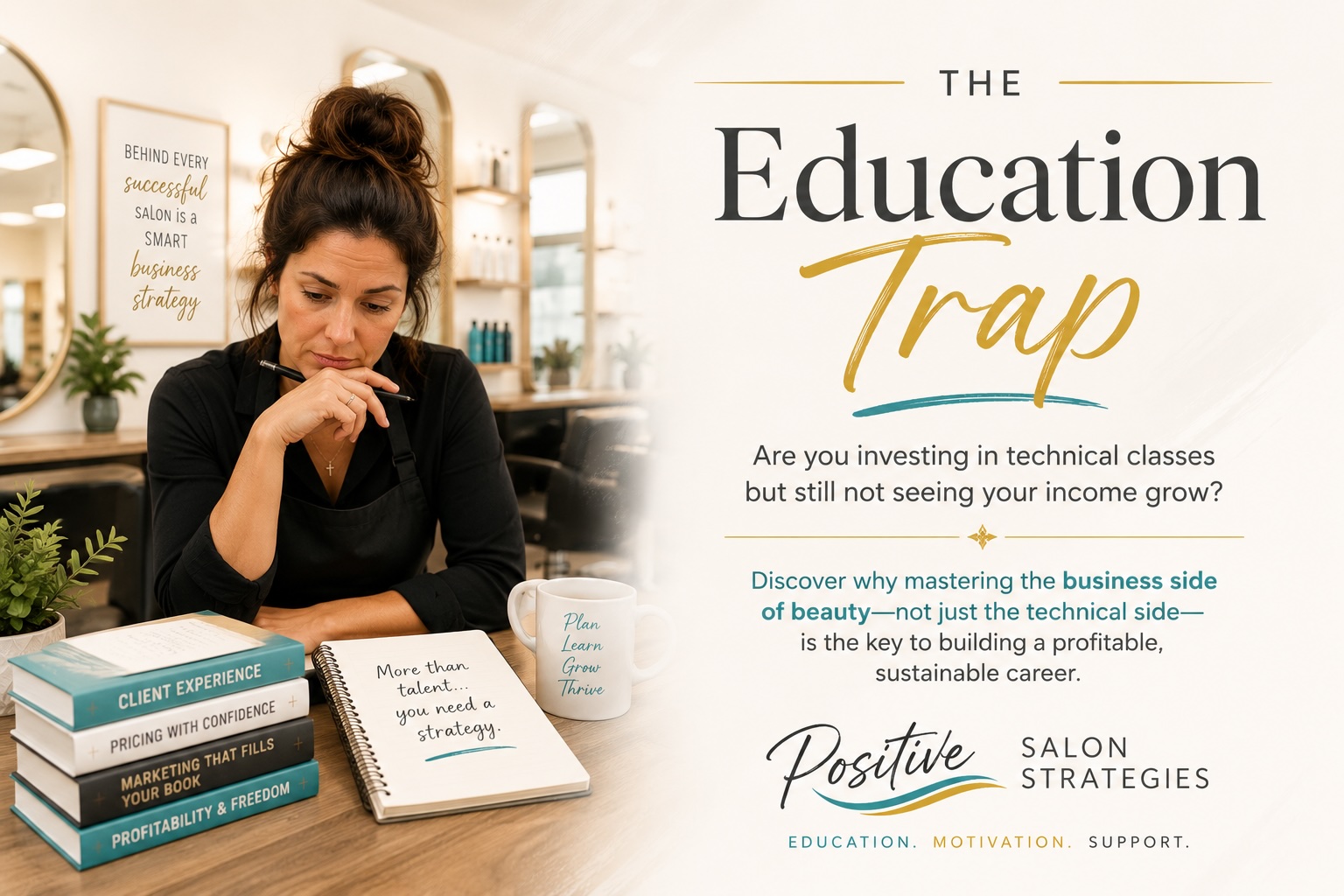
You know that feeling. You just spent a long weekend: and a good chunk of your savings: at an intensive hair coloring workshop or a luxury extension certification. You’re riding high on that post-class adrenaline. You’ve got a shiny new certificate to tape to your mirror, and you’re convinced that this is the thing. This is the skill that’s finally going to change your paycheck.
Then Monday morning rolls around.
You walk into the salon, ready to change lives with your new "reverse-shadow-foiling-whatever" technique, and you look at your book. It’s thin. The three clients you do have are your regulars who just want their usual trim and grey coverage. The high-ticket "transformations" you were promised in the class? Nowhere to be found.
Welcome to the Education Trap. It’s a cycle I see stylists get stuck in all the time, and honestly, it’s heartbreaking. You have the heart of an artist and the work ethic of a marathon runner, but you’re stuck thinking that "one more class" is the magic key to the life you actually want to live.
The Shiny Object Syndrome of the Beauty World
In our industry, technical education is the ultimate shiny object. We are creative people. We love to learn. We love the way a fresh technique feels under our hands. And the big brands and "influencer" educators know exactly how to sell that feeling to you.
They tell you that if you just master this one specific way to stitch in an extension or blend a blonde, you’ll suddenly be a "six-figure stylist." They show you pictures of packed schedules and luxury cars, and they tie it all back to the technical skill they’re selling.
But here’s the insider truth: They aren't selling you a business. They’re selling you a craft. And while being a master of your craft is beautiful, it’s not the same thing as being a master of your career.
You can be the most talented colorist in a three-state radius, but if you don't know how to get someone into your chair, how to keep them there, or how to price your time so you aren't paying the salon to work, you’re just a hobbyist with very expensive tools.

Why "Getting Better" Doesn't Always Mean "Getting Paid"
I want you to think about the last three classes you took. How much did they cost? Not just the ticket price, but the travel, the hotel, the missed income from taking days off, and the tools you "had" to buy afterward.
Now, look at your bank account. Has your income increased by at least that much since you took them?
For most stylists, the answer is a quiet, painful no.
The trap is believing that technical skills create demand. They don't. Marketing creates demand. Communication creates demand. Client experience creates demand. Your technical skill is just what you do once the demand has already been created.
If you have a gap in your schedule, taking another foiling class is like buying a faster engine for a car that doesn't have any wheels. It doesn't matter how powerful the engine is; the car isn't going anywhere. You’re spending money to improve a service that people aren't even booking yet.
The Silent Cost of Over-Educating
There’s a specific kind of burnout that comes from the Education Trap. It’s the exhaustion of feeling like you’re doing "everything right" and still coming up short.
You’re watching people on Instagram who might not even be as good as you are technically, yet their books are closed and they’re taking three-week vacations. It feels unfair. You start to think, Maybe I just need one more certification. Maybe I’m just not "pro" enough yet.
Stop right there. That’s the "tough love" part of this conversation.
If you’ve been behind the chair for more than a year and you’re still struggling to pay your booth rent or take home a real paycheck, the problem isn't your hands. It’s your head. It’s the business side of beauty that they skipped over in cosmetology school and that the "hair-lebrity" educators aren't teaching you.

You’ve been taught how to be a great employee or a great artist, but no one taught you how to be a profitable professional. You’re likely missing the real business skills that actually move the needle:
The psychology of why a client chooses you over the salon down the street.
How to talk about money without feeling like you’re "selling" or being "pushy."
The math of your service menu: not just what the girl next to you charges, but what you need to charge to actually retire one day.
The systems that turn a one-time walk-in into a loyal client who wouldn't dream of seeing anyone else.
The Artist’s Ego and the Empty Chair
It’s hard to admit that we need help with the "boring" stuff. We’d much rather spend eight hours learning a new braiding technique than one hour looking at a profit and loss statement. Our egos want to be the "best" in the room.
But I’ve sat with too many stylists who have a wall full of certificates and a heart full of anxiety because they can’t afford their car payment. I’ve seen talented professionals leave the industry altogether because they "just couldn't make it work."
They didn't fail because they weren't good enough at hair. They failed because they were stuck in the Education Trap. They kept investing in the what and never invested in the how.

Changing the Way You Invest in Yourself
I’m not saying you should never take another color class. Of course you should stay current. But there has to be a balance.
If you aren't where you want to be financially, your next investment shouldn't be another technical certification. It should be learning how to actually run the business you’ve already built.
Think about it this way: If you learned how to increase your client retention by just 10%, or how to effectively raise your prices without losing your "good" clients, that would pay for every technical class you ever wanted to take for the rest of your career.
That is the difference between being a stylist who is "busy but broke" and a salon professional who is building a legacy.
Finding the Missing Piece
If any of this hits home, if you’re tired of the "class-high" fading into "Monday-morning-blues," it’s time to stop looking for the answer in a new bottle of lightener or a different brand of shears.
You already have the talent. You’ve already put in the hours. Now, you just need the strategy to make that talent work for you, instead of you working yourself into the ground for it.

This is exactly why Jeanne started Positive Salon Strategies. We don't teach you how to cut hair: we assume you’ve already got that covered. We teach you everything else. The stuff that actually keeps the lights on and the stress levels down.
If you’re ready to stop the "one more class" cycle and start seeing the results you were promised when you first signed up for beauty school, you need to look at things differently.
The secrets to a profitable, professional, and actually peaceful career aren't hidden in a technical manual. They’re in the business strategies that turn an artist into a powerhouse.
Stop falling for the trap. Start building the business.

Find out how to finally bridge the gap between your talent and your bank account at Genie’s Wisdom.